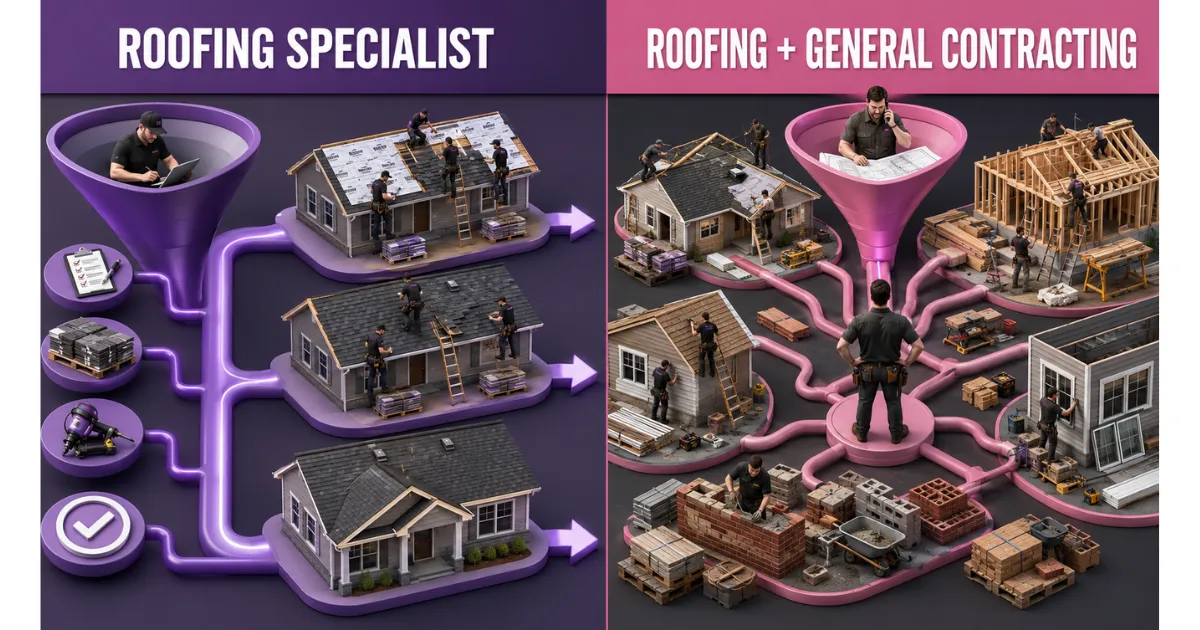
Why Roofing Companies Make More Money Than Roofing & General Contractors
Offering more services can look like a direct path to growth. Yet every additional service creates another business to operate inside the business. Well-run general contractors can be highly profitable. The advantage of specialization is reduced complexity and repeated opportunities to improve the same process.
1. Better estimating
Roofing estimators repeatedly see the same cost drivers: squares, pitch, layers, access, decking, flashing, ventilation, disposal, labor, and material systems. With consistent job costing, assumptions become sharper. A mixed contractor estimates different labor, schedules, and risks across many trades, which makes reliable benchmarks harder to build.
2. Better production systems
A specialized company can standardize the path from signed contract to final collection. Ordering, scheduling, crew assignment, quality checks, documentation, warranties, and communication follow a familiar rhythm. General contracting has more trade dependencies and project-specific sequences. Complexity can be profitable, but it must be priced and managed.
3. Better margin control
Roofers can establish target margins by job type and investigate deviations quickly. Material usage, labor, disposal, supplements, and commissions are easier to compare across similar work. In a mixed business, strong results in one division can hide weak results in another. Specialization does not guarantee margin. It makes problems easier to see.
4. Easier bookkeeping
A focused company can shape its chart of accounts, job-cost categories, commission rules, and reports around one operating model. A roofing and general contracting company often needs more cost codes, more vendor types, different margin targets, and more complex work-in-progress reporting. Clean books help the owner act while there is still time.
5. More focused overhead
Each service may require equipment, insurance, training, suppliers, licensing, software, marketing, and supervision. A specialist can invest deeply in tools that support its core work. The point is not always lower total overhead. It is overhead supporting a narrower, measurable production engine.
6. Stronger branding
Customers and referral partners understand what a specialist does. Marketing can speak to a specific problem and buying process. A clear identity also guides internal decisions: Does this opportunity strengthen what we are built to do? General contractors can build strong brands too, especially around a defined market or project type.
Focus is an operating decision
Roofing is not easy. It carries safety risk, cash demands, seasonality, insurance issues, and warranty exposure. The advantage comes from choosing a repeatable model and improving it. A company offering both roofing and general contracting should track revenue, direct cost, margin, backlog, and overhead by division.
More services are not the only way to grow
Growth can come from better close rates, larger average jobs, production capacity, service agreements, geographic density, and retention. Before adding a service, ask whether you understand its margin, systems, overhead, reporting, and effect on the core. More revenue sources do not always create more profit. Focus often does.
